
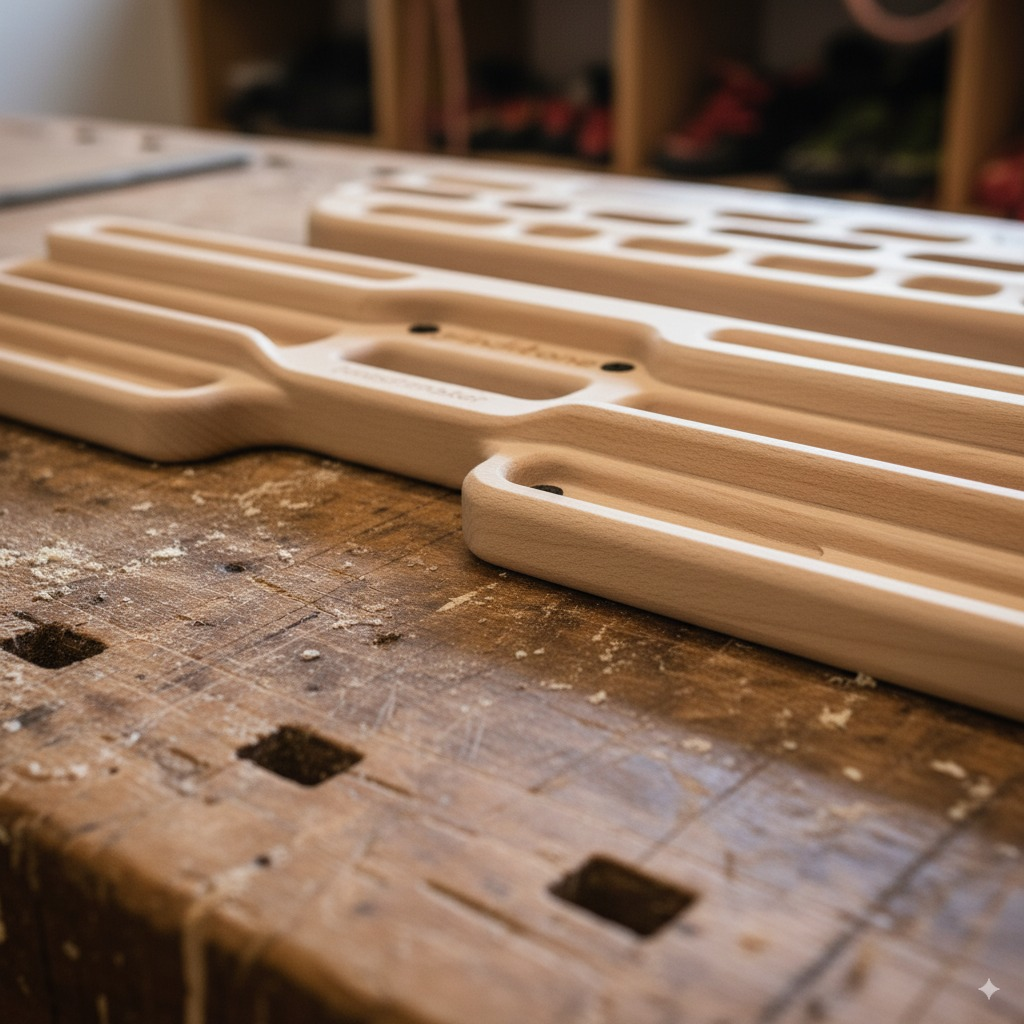

After weeks of research, I’ve finally identified the hangboards that stand out from the pack.
While every board that made the final cut is a fantastic choice, they each have unique strengths. I analyzed everything from the ergonomics of each pocket to the skin-friendliness of the texture to pinpoint exactly where each model excels.
Whether you need the undisputed all-around champion, a budget-friendly workhorse, or a specialized board to target specific weaknesses, my in-depth review will guide you to the perfect tool for your climbing goals.
Table of Contents
Cliff Culture’s Top Picks for 2025
Best Overall: Tension Climbing Grindstone

- Multiple edge sizes
- Skin-friendly wood
- Symmetrical design
An impeccably crafted wood hangboard, the Grindstone features a versatile and intuitive layout. Its skin-friendly texture and balanced design make it the perfect tool for dedicated, long-term training.
Best Value: Tension Flash Board

- Multiple edge sizes
- Skin-friendly wood
- Symmetrical design
The Flash Board distills training down to its powerful essentials. It features the premium, skin-friendly wood Tension is known for in a compact, no-frills design that delivers maximum performance for the price.
Best Hold Variety: Trango Rock Prodigy Training Center

- Multiple edge sizes
- Skin-friendly wood
- Symmetrical design
The Rock Prodigy’s signature two-piece design promotes shoulder-safe, ergonomic training tailored to the user’s body. With an unmatched variety of holds, it’s the ultimate system for athletes looking to meticulously target and eliminate weaknesses.
Most Space Efficient: Beastmaker 1000

- Multiple edge sizes
- Skin-friendly wood
- Symmetrical design
The legendary Beastmaker 1000 packs a powerhouse of challenging holds into an ultra-compact, skin-friendly wood design that fits anywhere. It is the standard for powerful training where space is limited.
Best for Beginners: So iLL Meagan Martin Training Tiles

- Skin-friendly wood
- Multiple edge sizes
- Symmetrical design
This innovative modular system is designed to grow with a climber’s strength. Its comfortable, beginner-friendly holds build confidence and make hangboarding approachable for everyone.
Comparison Overview
| Feature | Tension Grindstone | Tension Flash Board | Trango Rock Prodigy | Beastmaker 1000 | So iLL Meagan Martin Tiles |
| Primary Material | Poplar Wood | Poplar Wood | Polyurethane | Tulipwood | Polyurethane |
| Mounting Style | Fixed, Wall-Mounted | Portable, Suspension | Fixed, Two-Piece | Fixed, Wall-Mounted | Modular, Individual |
| Distinct Hold Types | Edges, Jug | Edges only | Edges, Pockets, Slopers, Pinches | Edges, Pockets, Slopers | Jugs, Edges |
| Total Grip Positions | ~18 | 8 | 40+ | ~22 | Varies by tile |
| Pocket Variety | None | None | High (2, 3, 4-finger, variable depth) | High (2, 3, 4-finger) | Limited to none |
| Sloper Variety | None | None | Yes (Variable angles) | Yes (35° and 20°) | None |
| Smallest Edge | 8 mm | 8 mm | ~12 mm | ~15 mm (pocket) | ~25 mm |
| Key Feature(s) | Engraved depths, Phone holder | Ultra-portable, Rotational stability | Ergonomic custom width | High density of holds, Space-efficient | Scalable, Beginner-friendly |
Best Overall
Tension Climbing Grindstone
To be crowned the best overall hangboard, a product needs to strike a perfect balance between comfort, versatility, and effective design.
It must serve a wide range of climbers, from those breaking into intermediate grades to seasoned veterans pushing their limits. The Tension Climbing Grindstone achieves this with near-flawless execution.
- Versatile design with perfectly balanced holds for all-around training.
- Skin-friendly premium wood allows for longer, more comfortable sessions.
- Built to last and CNC-milled for perfect symmetry and durability.
The first thing you’ll notice is the impeccable finish of the poplar wood. It’s CNC-milled for perfect symmetry and features a comfortable edge profile that’s gentle on the skin, allowing for more frequent and longer training sessions without sacrificing grip.
The hold layout is exceptionally versatile and intuitive. It includes a full-width top jug for warming up and a comprehensive set of edges for every level, progressing from a massive 50mm all the way down to a razor-thin 8mm edge for limit crimping.
The design is packed with thoughtful details, including a central phone holder to time your hangs and engraved depth markings that eliminate guesswork. It’s this combination of an expansive hold variety, premium construction, and climber-centric features that makes the Grindstone our top pick for any athlete serious about improvement.
Best Bang for the Buck
Tension Flash Board
The Tension Flash Board offers the highest performance-to-price ratio. For climbers who want a no-frills, high-quality training tool without the premium price tag, there is no better option.
- Offers maximum value with premium quality at an unbeatable price.
- Features essential holds focused on the core grips for building real strength.
- Compact yet effective no-frills design that delivers results.
This is a no-frills, high-performance tool that distills hangboarding down to its core essentials. It is packed with a full progression of edges, including 20mm, 15mm, 10mm, and a challenging 8mm crimp, ensuring you never miss a training session or start a climb cold again.
It skips the niche pockets and pinches, focusing on the holds that deliver the most significant strength gains. This streamlined approach means you get a top-tier training tool that will last for years, all at a price that makes it accessible to nearly everyone.
Its compact, cylindrical design is not only light and easy to pack but also extremely resistant to rotation, providing a stable platform wherever you are. You can hang it from a pull-up bar, a sturdy tree at the crag, or even pull against your foot for resistance.
Best Hold Variety
Trango Rock Prodigy Training Center

The “Best Hold Variety” award goes to the board that offers the most comprehensive set of grips for targeted, anatomical training. For climbers who follow structured plans and want to isolate specific finger combinations and grip types, the Trango Rock Prodigy Training Center is in a league of its own.
- Ergonomic two-piece design protects your shoulders and promotes good form.
- Unmatched variety with a massive array of holds for targeting weaknesses.
- Best for serious athletes pursuing structured training.
Its signature two-piece design is its greatest strength. By allowing you to mount the halves at a custom width, it promotes better shoulder ergonomics and more closely mimics your natural climbing posture.
But the real story is the sheer number of holds. The Rock Prodigy is a finger-strength laboratory, featuring a massive array of variable-depth two, three, and four-finger pockets, a wide range of crimp rails from incut to sloping, and a set of uniquely challenging pinches. This unparalleled variety allows you to meticulously target weaknesses and train every possible grip configuration, making it the ultimate tool for the data-driven athlete.
Most Space Efficient
Beastmaker 1000
The legendary Beastmaker 1000 delivers maximum training potential in the smallest possible footprint. It has long been the standard-bearer in this category, and for good reason.
- Space-efficient design that fits perfectly above doorways.
- Powerfully compact and packed with a variety of challenging holds.
- Legendary quality carved from fine-textured, skin-friendly wood.
Carved from a single piece of fine-textured tulipwood, the Beastmaker 1000 is significantly narrower than most of its competitors, allowing it to be mounted above doorways and in tight spaces where other boards simply won’t fit.
But don’t let its size fool you, because this board is a powerhouse. It features a devious set of slopers (35 and 20 degrees), a variety of pockets that test different finger groupings, and a set of core edges for building fundamental strength. While it’s geared more towards intermediate climbers, its compact and challenging design makes it the perfect tool for anyone looking to build powerful fingers without sacrificing living space.
If you need more variety, it’s worth checking out the Beastmaker 2000, which has 45-degree slopers, mono, and a middle jug for one-arm hangs.

Best for Beginners
So iLL Meagan Martin Training Tiles
The best hangboard for an entry-level climber should be approachable, comfortable, and scalable. It needs to build confidence and strength without causing the intimidation or injury that can come from more aggressive boards. The So iLL Meagan Martin Training Tiles win this category by completely rethinking the beginner hangboard experience.
- Modular system lets you start simple and add holds as you get stronger.
- Comfortable and beginner-friendly design builds confidence.
- Grows with you as the perfect, scalable introduction to strength training.
Instead of a single, monolithic board, the Training Tiles are a modular system. New climbers can start with just one or two tiles, like the deep, incut jug or the large four-finger edge, and then add more holds as their strength and confidence grow.
The holds themselves are made from a polyurethane resin that is incredibly comfortable, with large, rounded radii that are gentle on tendons and encourage proper form. It’s a fun, effective, and less intimidating way to start a lifelong journey of strength training.
Sign up to our newsletter!
Get stories, tips, and community updates from Cliff Culture delivered to your inbox. Enter your email to sign up.
Your message has been sent

By submitting your information, you`re giving us permission to email you. You may unsubscribe at any time.
Factors to Consider When Choosing a Hangboard

By isolating your fingers, hands, and forearms, a hangboard allows you to target specific weaknesses and build serious finger strength.
But with so many options, choosing the right climbing hang board can be daunting. This guide will walk you through everything you need to know.
1. Your goal
The first step is to identify your experience level and training goals.
- Beginner Climbers: If you’re new to hangboard training (generally, climbing for less than a year), your focus should be on building a solid foundation and injury prevention. The best hangboard for beginners will have larger, more comfortable holds, including big jugs for warming up and doing pull-ups.
- Intermediate Climbers: You have consistent climbing experience and are ready to target specific grip types. Look for a training board with a wider variety of hold types, including different edge sizes, pockets, and moderate slopers. Boards like the Beastmaker 1000 are perfect for this stage.
- Advanced Climbers: You are an experienced climber looking to push your limits. Your ideal climbing fingerboard will feature micro-edges, poor slopers, and challenging pockets to fine-tune your grip strength. The Tension Grindstone MKII is a top choice for its precise and difficult holds.
2. Hold types
The variety of holds on a hang board dictates the type of grip training you can do.
- Edges/Crimps: Look for a board with a good range of edge depths, from comfortable 15-20mm edges to tiny 6-8mm crimps for advanced progression.
- Slopers: These are crucial for developing open-hand strength and body tension. A board with challenging slopers will directly translate to better performance on real rock.
- Pockets: Pockets train strength on one, two, or three fingers. This is a highly specific and important part of finger strength training.
- Pinches: Some hangboards, like the Trango Rock Prodigy Natural, offer pinch grip options. Pinch strength is often a weakness for climbers and is a great metric to train.
- Jugs: Large, comfortable holds essential for warming up, cooling down, and performing exercises like pull ups to build upper body strength.
3. Material
Hangboards primarily come in two materials: wood and plastic (polyurethane resin).
- Wooden Hangboards: A wood hangboard is the top choice for most climbers. Wood is very skin friendly, causing less abrasion than plastic, which allows for longer, more productive training sessions. The consistent, low-friction texture is ideal for pure strength building.
- Plastic/Resin Hangboards: Resin boards often feature a wider variety of hold shapes and textures that can better mimic outdoor rock. While tougher on the skin, they can be a good alternative if you want to train on more diverse grip positions.
Learn More About Climbing Gear


Frequently Asked Questions
What is the best hangboard for beginners?
The best hangboard for beginners is one that prioritizes safety and foundational strength building. We recommend a wooden hangboard like the So iLL Meagan Martin Training Tiles or the Beastmaker 1000. They both feature a variety of large, comfortable edges and jugs, which are perfect for learning proper form and building initial strength without being too aggressive on the skin or joints.
How often should I use a hangboard?
For most climbers, 2-3 hangboard training sessions per week is the ideal frequency. It is crucial to have at least one full rest day between sessions to allow your muscles and tendons to recover and get stronger. Overtraining on a finger board climbing tool is a common cause of injury, so always listen to your body.
Are wooden hangboards better than plastic ones?
It largely comes down to personal preference, but many climbers favor wood hangboards. Wood is significantly more skin friendly, allowing for longer training without pain. Its consistent texture is also ideal for gauging pure strength gains. Plastic boards can offer more varied and rock-like textures, but they can also be harsher on the skin. For pure finger training, wood is generally considered the superior material.
Can I just use a hangboard to get better at climbing?
A hangboard is one of the most effective tools for increasing your raw finger strength, which is a key determinant in climbing success. However, climbing demands more than that. To see the biggest improvements in your overall climbing performance, you should combine your hangboard routine with regular climbing sessions at your local climbing gym or outdoors. This allows you to apply your newfound strength and refine your climbing technique.