
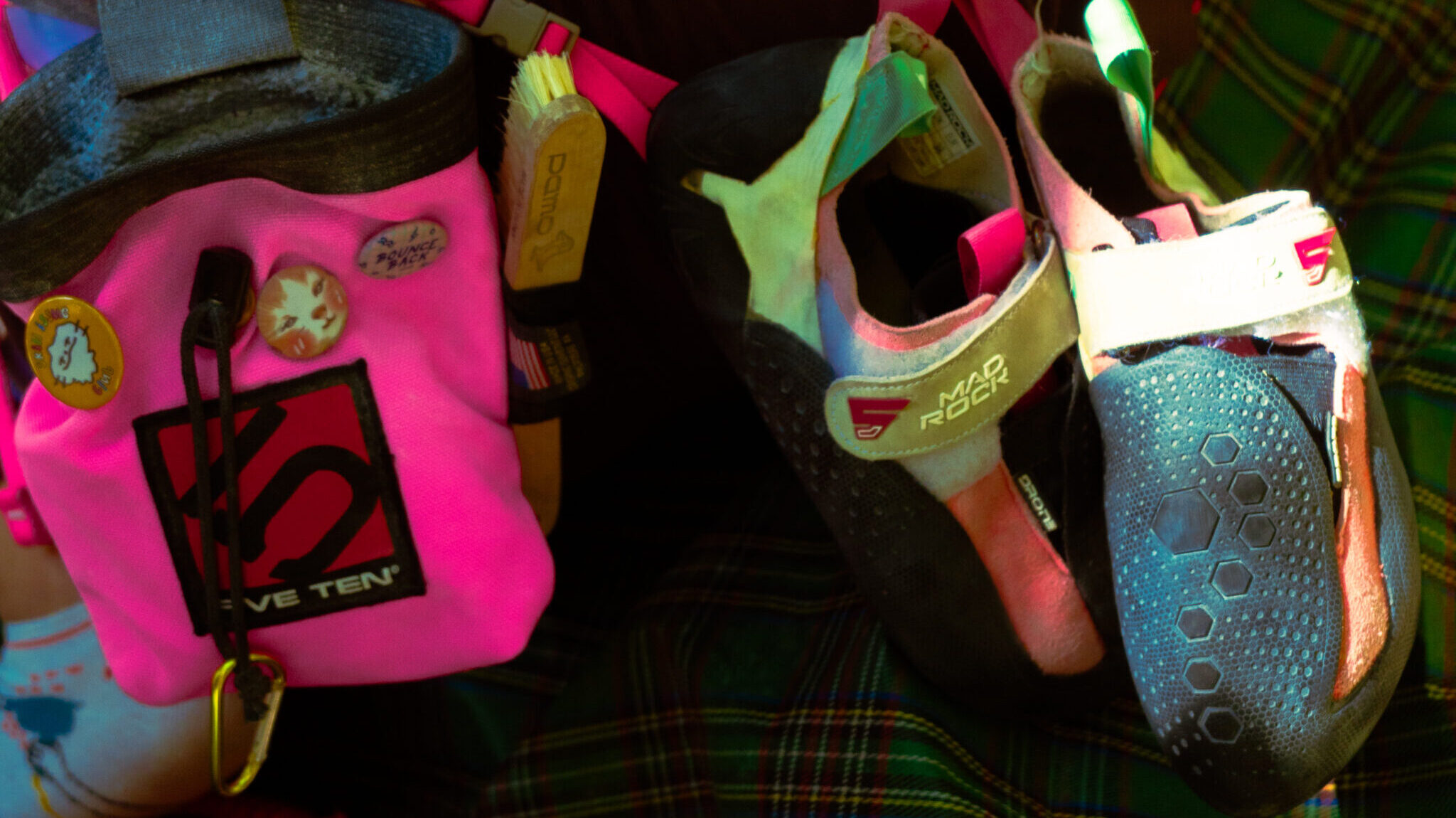

When I started climbing, I learned to dislike rental shoes – thinking about how much harder I’d be able to climb if I had real climbing shoes. The problem was – I didn’t have a clue what kind of shoe I needed.
Every single model looked the same to me. Every brand claimed to be the best. And if I picked wrong? I’d have wasted money on shoes that hurt like hell, killed my performance, and made me dread every climb.
Unfortunately, that is exactly what happened to me.
I bought my first pair of climbing shoes when I was only a month into climbing. I immediately fell in love with the sport and decided to pull the trigger on a secondhand shoe—the La Sportiva Miura, famously one of the best edging shoes ever made. It was sold to me by a climber who had decades of experience. However, as I would come to learn, it was the exact opposite of a beginner shoe. With each foothold I stepped on, the more I hated that pair. It was the wrong shape for my feet, extremely stiff, and much too aggressive for the beginner that I was.
Within a week of owning that pair, I sold it, did some research, and bought a brand new pair of La Sportiva Tarantula Boulders—a shoe that was way more comfortable and beginner-friendly. I still use it for endurance sessions to this very day.
What’s in this guide:
I wrote this guide so you wouldn’t have to waste time, money, and precious foot health on the wrong shoe. I’ll walk you through every critical factor, from understanding your personal climbing needs to decoding a shoe’s anatomy and nailing the perfect fit—so you can buy your next pair with total confidence.
Let’s start with the first problem I encountered in my climbing shoe journey.
Why you shouldn’t buy just any climbing shoe
Picking the right climbing shoe is the most important gear choice you’ll make.
Shoes that fit well become part of your body, helping you stand on tiny ledges, grip slippery surfaces, and move with confidence. If they’re too loose, your foot slips around and you lose control. If they’re too tight, the pain breaks your focus and ruins the fun.
A good fit lets you trust your feet, use your legs more, and your arms a little less. Taking time to find the perfect pair helps you climb safer, improve faster, and enjoy climbing a bit more.
3 Questions to Ask Before You Buy
Before you even start looking at shoes, you need to understand your own needs as a climber. Asking a few key questions can narrow down the overwhelming number of options and point you toward the right category of shoe. This self-assessment saves you time and helps you make a much more informed decision.
Your answers will create a personal profile that guides your search. Think about your current abilities, the kind of climbing you plan to do most often, and what you’re willing to spend. Getting clear on these three areas is the foundation for finding the right shoe for you.
1. How long have you been climbing?
Your current climbing skill level is the first major factor to consider when choosing a shoe. The needs of a first-time climber are vastly different from those of an expert who has been climbing for years. Your experience level dictates whether you should prioritize comfort and support or specialized, high-performance features.
For those new to the sport, the primary goal is to spend time on the wall learning movement and building foot strength. Therefore, beginners generally benefit from shoes that prioritize comfort and durability to facilitate learning. A shoe that is comfortable allows you to climb for longer periods without pain, while durable construction can withstand the less precise footwork common among novices.
More advanced climbers may opt for softer, more aggressive shoes designed for specific challenges, but these are often too uncomfortable and demanding for a beginner’s feet.
2. What type of climbing do you do most?
The type of climbing you will be doing most often is a crucial factor in your shoe selection. Different climbing disciplines place different demands on your feet and footwear, so a shoe that excels in one area may be a poor choice for another. Whether you’re climbing in a gym or outdoors, the terrain will dictate the ideal shoe characteristics.
Bouldering and steep sport climbing often involve powerful moves on overhanging walls. For this, aggressive, downturned shoes are generally preferred, as they help you pull with your toes by turning them into rubber claws. Conversely, traditional and multi-pitch climbing require you to be in your shoes for hours, making flatter, more comfortable neutral shoes a better choice.
Your primary climbing environment—from indoor bouldering gyms with large volumes to outdoor crags with tiny granite edges—should be the main guide for your decision.
3. What’s your budget?
Climbing shoes can range from under $100 for entry-level models to over $200 for high-performance shoes. Deciding how much you want to spend beforehand will make the shopping process much more efficient.
For beginners, I often recommend starting with a more affordable climbing shoe, as their developing and less precise footwork tends to wear out the rubber quickly. Paying a premium for advanced features you don’t need yet doesn’t really make sense.
As you progress, you can invest in a more specialized, higher-end shoe that matches your improved skill and specific climbing goals.
Sign up to our newsletter!
Get stories, tips, and community updates from Cliff Culture delivered to your inbox. Enter your email to sign up.
Your message has been sent

By submitting your information, you`re giving us permission to email you. You may unsubscribe at any time.
The Anatomy of a Climbing Shoe
To choose the right shoe, you need to know what you’re looking at. Every shoe is a combination of different design choices that make it better for certain types of climbing and certain types of feet.
The five main elements to consider are:
- The shoe’s profile
- Its stiffness
- The closure system
- The outsole rubber
- The upper material
Each of these parts plays a distinct role in the shoe’s overall feel and function. By learning to identify these features, you can look at a shoe and know instantly whether it’s designed for comfort on long routes, precision on tiny holds, or power on steep overhangs.
1. Shoe Profiles
A climbing shoe’s profile refers to the “downturn” or curvature of its shape from heel to toe. Modern climbing shoes are typically categorized into three main profiles based on their shape: neutral, moderate, and aggressive. This profile is the most visible indicator of a shoe’s intended purpose.
- Neutral Profile: Neutral climbing shoes feature a flat profile and a relaxed fit that allows the toes to lie flat, prioritizing comfort for all-day wear. This makes them a popular choice for beginners and multi-pitch climbers. An example is the La Sportiva Tarantulace.
- Moderate Profile: These shoes have a slightly downturned shape, offering a balance between comfort and performance that makes them versatile all-arounders. They are great for technical face climbing and slightly overhanging routes. The Scarpa Vapor V is a classic moderate shoe.
- Aggressive Profile: Characterized by a very downturned, “claw-like” shape, these shoes are ideal for challenging, overhanging climbs where they help climbers “toe in” and pull with their feet. The La Sportiva Solution is a famous example of an aggressive shoe.
Typically, you’ll want to choose a shoe that matches your primary climbing style. A neutral shoe provides the comfort needed for long days and learning basic technique, while moderate and aggressive shoes provide the specialized performance needed for harder climbs. The more downturned the shoe, the more power it focuses onto your big toe for steep terrain.
2. Stiffness
The stiffness of a climbing shoe’s sole determines how much support it provides versus how well you can feel the rock beneath your feet. This is a critical tradeoff between support and sensitivity. Neither is inherently better; the right choice depends on the type of climbing you do and your personal preference.
Stiff shoes have a rigid midsole that provides excellent support for your foot muscles. This makes them great for standing on tiny edges for long periods, as the shoe does more of the work. They are often preferred for vertical face climbing and by beginners whose feet are still developing strength.
On the other hand, soft shoes are often preferred for modern indoor climbing, which frequently involves smearing on large volumes, while stiff shoes provide superior support for standing on small footholds and edges. Soft shoes are highly sensitive, allowing you to feel subtle features in the rock and are favored for friction-based climbing and steep bouldering.
3. Closure System
The way a climbing shoe closes affects both its convenience and the precision of its fit. The three main closure systems are laces, Velcro straps, and elastic slippers, each with distinct advantages and disadvantages.
- Laces: Lace-up closures are considered the most versatile style because they offer the highest degree of adjustability. You can fine-tune the fit across your entire foot, tightening them for performance or loosening them for comfort.
- Velcro: Also known as hook-and-loop, climbing shoes with Velcro (strap) closures are extremely convenient. This makes them a very popular choice for bouldering and gym climbing, where you frequently take your shoes off between attempts.
- Slippers: These shoes use an elastic closure system for a snug, sock-like fit. Slip-on climbing shoes are characterized by their high sensitivity and low profile, which is advantageous for training and fitting into thin cracks.
The choice often comes down to personal preference and climbing style. Laces offer a customized fit perfect for long routes where your feet might swell. Velcro provides the speed needed for gym sessions. Slippers deliver maximum sensitivity for climbers who want to feel every nuance of the hold.
4. Outsole Rubber
The rubber on the bottom of your shoe, known as the outsole, is what connects you to the rock. The specific compound and thickness of this rubber have a massive impact on the shoe’s grip, durability, and sensitivity.
The thickness of the outsole is a trade-off between durability and feel. Thicker climbing shoe outsoles (4-5.5mm) offer greater durability and support, while thinner outsoles (3-4mm) provide enhanced sensitivity for feeling subtle rock features. Beginners often benefit from thicker rubber that lasts longer, while advanced climbers may prefer thinner rubber for more precision.
Different brands also use proprietary rubber formulas, like Vibram’s XS Edge (stiff and durable) and XS Grip2 (soft and sticky), each excelling in different situations.
5. Upper Materials
A climbing shoe’s upper is the material that wraps around your foot, and it’s typically made of either leather or a synthetic fabric. This choice is important because it dictates how much the shoe will stretch and conform to your foot over time.
Leather uppers are known for their ability to stretch and mold perfectly to the shape of your foot, providing a custom-like fit after a break-in period. However, this means you may need to size them more tightly to begin with.
On the other hand, leather climbing shoes, particularly unlined leather, can stretch significantly (up to a full size or more), while synthetic shoes experience minimal to no stretch, providing a consistent fit from day one. Synthetic shoes are also generally better at maintaining their original shape and performance characteristics over their lifespan and are a great choice for vegans.
Sign up to our newsletter!
Get stories, tips, and community updates from Cliff Culture delivered to your inbox. Enter your email to sign up.
Your message has been sent
By submitting your information, you`re giving us permission to email you. You may unsubscribe at any time.
How to Find the Perfect Climbing Shoe Fit
This is the most critical part of the entire process. No amount of advanced features or sticky rubber can make up for a poor fit. The right fit ensures you can effectively use the shoe’s design, transfer power to your toes, and climb without distracting pain. Your goal is to find a shoe that feels like a natural, high-performance extension of your foot.
Achieving this requires a hands-on approach. You must try shoes on, preferably at a gear shop with a small climbing wall where you can test them on actual holds. Pay close attention to how the shoe interacts with your specific foot shape, from your toes to your heel. Getting the fit right will have a greater impact on your climbing than any other single factor.
Sizing Your Climbing Shoes Correctly
You should start by trying on a shoe in your normal street shoe size, but be prepared to go up or down from there. Unfortunately, climbing shoe sizing is not standardized across brands; each manufacturer uses its own unique lasts, meaning a size from one brand will fit differently than the same size from another. This makes buying online without trying shoes on first very risky.
For the most accurate assessment, it is recommended to try on climbing shoes later in the day, such as in the evening, because feet tend to swell throughout the day. When you put the shoe on, your heel should be pushed firmly against the back. Then, when you tighten the closure system, your toes should be right at the very end of the shoe, either lying flat (in a neutral shoe) or curled (in a moderate or aggressive shoe).
The Ideal “Performance Fit”
The ideal “performance fit” should be very snug, but it should not be excruciatingly painful. For optimal performance, climbing shoes must have a snug fit, like a second skin, with no dead space (air pockets) or painful pressure points (hot spots). Your toes should fill the front of the shoe completely, and your heel should feel locked in and secure, with no lifting when you stand on your toes.
There’s a common misconception that shoes must be agonizingly tight to perform well. While a snug fit is necessary, climbing shoes should fit snugly, but they should not be painful, as excessive pain can hinder technique and detract from the climbing experience.
If you feel sharp, pinching pain or intense pressure on a specific joint, the shoe is likely the wrong shape for your foot, and you should try a different model. Finding this balance is key to selecting shoes that aren’t too tight.
How to Match a Shoe to Your Foot Shape
Every person’s foot is unique, which is why a shoe that works perfectly for your friend might be a terrible fit for you. To find the right match, it is essential to find a shoe built on a last that matches your specific foot anatomy because individual foot shapes vary in terms of width, volume, and toe profile. The “last” is the foot-shaped model that a shoe is built around.
When you try on a shoe, check for any empty space. This is a sign of a poor fit. A key indicator that a climbing shoe is too big is the presence of loose, baggy, or bunching upper material, particularly when pressure is applied to the toes. Pay attention to your toe shape—whether your big toe is longest or your second toe is longest will affect which shoe shapes feel best. The right shoe will hug your foot evenly without any major gaps or painful pressure points.
Men’s vs. Women’s vs. Low-Volume Fits
It is important to understand that in the context of climbing shoes, terms like “men’s” and “women’s” refer more to a general foot shape and volume than to gender. Don’t let the label prevent you from trying on a shoe that might be a perfect match for your foot. Many climbers wear models that are not designated for their gender.
Typically, “women’s” versions of a shoe are built on a lower-volume last. This often means they have a narrower mid-foot and a smaller heel cup compared to the “men’s” or unisex version. Many brands are now shifting to terms like “High Volume” (HV) and “Low Volume” (LV) to be more accurate and inclusive.
The best advice is to ignore the label and focus entirely on which shoe feels best on your foot.
Common Sizing Mistakes to Avoid
- Buying shoes that are excessively painful. A performance fit is snug, not agonizing.
- Leaving too much dead space. Gaps in the heel or toe box will compromise performance.
- Forgetting that leather shoes stretch. You need to account for this when sizing an unlined leather shoe.
- Ignoring your foot shape. A shoe that doesn’t match your foot’s width or toe profile will never fit well.
- Relying solely on your street shoe size. Every brand is different, so you must try them on.
These mistakes often stem from outdated advice or a misunderstanding of what a “performance fit” truly means. The myth of needing brutally tight shoes can lead climbers to buy shoes that are too small, causing unnecessary pain and even long-term foot problems. Conversely, prioritizing comfort too much can result in a shoe that is too loose to provide the precision needed for confident climbing.
The Best Climbing Shoes for Beginners
For climbers just starting out, the best shoes are those that encourage learning and allow for long, comfortable sessions at the gym or crag. The focus should be on building fundamental skills, not on enduring painful footwear. Beginner shoes are specifically designed with this in mind.
Several models are consistently recommended for beginners because they excel at providing the right mix of comfort, performance, and value. As a starting point, consider trying some of these on:
Popular and highly-regarded beginner shoes include the La Sportiva Tarantulace, which offers excellent adjustability with its lace-up design, and the Scarpa Origin, known for its comfortable, padded fit right out of the box. Another top contender is the Black Diamond Momentum, which features an innovative knit upper that provides exceptional breathability and comfort.
Each of these shoes provides the flat profile and supportive midsole that is ideal for those new to climbing.
What makes a good beginner climbing shoe?
A good beginner climbing shoe is defined by a few key features that work together to create a forgiving and supportive experience. These characteristics are intentionally chosen to help new climbers build strength and learn proper technique.
- Neutral Profile: A flat last keeps your foot in a natural, comfortable position, allowing you to wear the shoes for longer.
- Stiff Midsole: A stiffer sole provides extra support, which is helpful as your foot muscles are still developing. It makes standing on small holds feel easier.
- Durable Rubber: Thicker, harder rubber is used to withstand the scuffing and dragging that comes with learning footwork.
- Comfortable Fit: The overall design emphasizes a less aggressive fit to minimize pain and maximize time on the wall.
These features combine to form a shoe that won’t hold you back as you learn. The stiff, supportive platform builds confidence on small footholds, the durable rubber forgives sloppy footwork, and the comfortable, flat profile ensures that your focus remains on the climb, not on the pain in your feet. This combination helps foster a positive early experience with the sport, which is crucial for long-term progression.
Caring for Your New Climbing Shoes
Once you’ve invested in the perfect pair of climbing shoes, you’ll want to make them last as long as possible. Proper care and maintenance not only extend the lifespan of your shoes but also keep them performing at their best.
A little bit of attention after each climbing session can go a long way. This includes properly breaking them in, keeping them clean, and knowing how to store them correctly. Taking these simple steps will protect your investment and ensure your shoes remain reliable partners on the wall.
How to Break In New Climbing Shoes
The break-in period is when your new shoes mold to the specific shape of your feet. For many shoes, especially leather models, this process is essential for achieving a perfect, comfortable fit. The key is to do it gradually to avoid unnecessary pain.
- Start by wearing them at home for 15-20 minute intervals while sitting down.
- Wear them at the climbing gym for your warm-up and then take them off between climbs.
- Avoid long, intense climbing sessions until they feel more comfortable.
- If the shoes are very tight, wearing a thin sock or putting a plastic bag over your foot can help you slide them on more easily during the first few sessions.
The goal of this process is to allow the shoe’s materials to slowly stretch and conform to the unique contours of your feet. Rushing this can be extremely painful and counterproductive. Patience is key, and you can find more detailed tips in our guide on how to break in climbing shoes.
How to Clean and Maintain Your Shoes
Keeping your shoes clean prevents the buildup of odor-causing bacteria and preserves the integrity of the materials. Proper storage is just as important.
Never leave your shoes in a hot car or stuffed at the bottom of a sweaty gym bag. After climbing, take them out and let them air dry completely. Use a brush to gently clean any chalk, dirt, or grime off the rubber soles, which helps maintain their stickiness.
If they become extremely dirty or smelly, you can hand wash them with a small amount of mild soap and cold water, then let them air dry completely away from direct sunlight or heat, which can damage the materials.
Ready to Find Your Perfect Pair?
While the options can seem endless, you now have the knowledge to make a confident decision. Remember: fit is everything, be honest about your skill level and primary climbing style, and take the time to understand a shoe’s basic anatomy.
The best next step is to take this guide and visit your local climbing gym or gear shop. Use their expertise and try on as many different models as you can. Feel the difference between a neutral and a moderate shoe, test the fit in the heel and toe, and stand on a few climbing holds.
Hopefully, unlike I was when I first started, you’re now ready to find the perfect pair of shoes to help you enjoy all the benefits of rock climbing and send your projects in style.
Learn More About Climbing Gear


Frequently Asked Questions
What is the most important factor when choosing climbing shoes?
The single most critical factor is fit. A proper fit is essential for both comfort and performance, allowing you to transfer power to your toes without painful hot spots or performance-killing dead space. A good fit helps you build trust in your feet, which is a cornerstone of good climbing technique.
What type of climbing shoe is best for a beginner?
Beginners should look for shoes with a neutral (flat) profile, a stiff midsole for support, and durable rubber. The primary goals are comfort and durability to allow for longer learning sessions on the wall while developing basic footwork.
Should my climbing shoes be painful to wear?
No, your climbing shoes should not be excruciatingly painful. The ideal “performance fit” is very snug, like a second skin, but excessive pain can hinder your technique and enjoyment. If you feel sharp, pinching pain, the shoe is likely the wrong shape for your foot, and it is important to find shoes that aren’t too tight.
How do I know what size climbing shoe to get?
Since climbing shoe sizing is not standardized between brands, you should start with your street shoe size and adjust from there. It is best to try them on in the evening when your feet are slightly swollen. A proper fit means your toes reach the very end of the shoe and your heel is secure with no empty space.
What’s the difference between neutral, moderate, and aggressive climbing shoes?
The profile refers to the shoe’s downturn. Neutral shoes are flat and prioritize comfort, making them ideal for beginners and all-day wear. Moderate shoes have a slight downturn for a balance of comfort and performance. Aggressive shoes have a sharp, claw-like downturn designed for maximum power on steep, overhanging climbs.
Does it matter if I buy leather or synthetic climbing shoes?
Yes, the material affects how the shoe fits over time. Leather uppers can stretch up to a full size, molding to your foot for a custom fit. Synthetic uppers experience little to no stretch, meaning their fit remains consistent from the first day you wear them.
How do I know when it’s time to resole my shoes?
It’s time for a resole when the rubber on the sole wears dangerously thin, especially around the toe. If you wear a hole completely through the rand (the rubber wrapping the toe) and into the upper material, a resole may no longer be possible and you might need a new pair.
How can I make my new climbing shoes more comfortable?
The break-in period is key to making new shoes more comfortable, especially leather models. This process should be done gradually by wearing them for short intervals at home and during warm-ups at the gym. For more detailed advice, see our guide on how to break in climbing shoes.